Showing posts with label Promissory Note. Show all posts

Friday, August 26, 2011

BOMBSHELL AT LIVING LIES


Bombshell Admission of Failed Securitization Process in American Home Mortgage Servicing/LPS Lawsuit

MOST POPULAR ARTICLES

EDITOR’S NOTE: It is comforting to know that at least some people are paying attention. From one of the largest servicers in the country comes an admission that securitization of mortgage loans was an illusion. The facts alleged by AHMSI  in its lawsuit against LPS are true in virtually all cases in which any bank or other entity has claimed an interest in a mortgage loan.
They are actually saying two things: first, they are saying that their practice was to create the documents supporting the foreclosure by an entity that was essentially picked at random and that these documents were created only as necessary in foreclosure litigation (otherwise they just proceeded with any old documents); second, they are saying that the people who signed those documents lacked any authority or appointment to represent any real party in interest and that the signature was forged on behalf of other people who also lacked any authority or appointment to represent any real party in interest.
In the four years that I have been analyzing and writing about this mortgage crisis it has been my consistent opinion that the original mortgage transaction was a single transaction between a borrower and the lender. The single transaction doctrine or the step transaction doctrine utilized in a myriad of other cases involving both real property law and commercial transactions create simplicity out of what appears to be a complex series of transactions. I have repeatedly said in my writings and in my presentations at seminars that those who participated in the securitization scam would prevail as long as they were able to direct the attention of a judge to only one part of the transaction, to wit: the part where the borrower receives the benefit of funding a loan. The burden is on borrowers to redirect the attention of the judge to include both sides of the transaction.
The lender’s side of the transaction is as simple as the borrower’s side. The lender funded or advanced money for the purpose of funding a mortgage loan. The pretender lenders don’t want any judge looking behind the veil. But the facts are clear. The lender in the transaction was a group of investors who never received any notice of the transaction with the borrower, much less the actual note and mortgage. The investor/lender received a mortgage bond that was supposedly backed by a perfected mortgage lien on the property owned by the borrower. Instead of naming the lender as the mortgagee, nominees were inserted into the documents executed by the borrower. The failure to disclose both the identity of the lender and the terms under which the lender advanced money (contained in the prospectus and the pooling and servicing agreement) results in an imperfect lien. (The test for a perfected lien is being able to determine the identity of the party from whom you would obtain a release).
At the time of the original transaction the party designated as the “lender” was powerless to execute a satisfaction of mortgage. By definition this means that the lien was never perfected. With few exceptions all of the entities that have been involved in the initiation of foreclosure proceedings have been nothing more than middlemen pretending to represent the investor/lender when in fact their intent was to divert money, proceeds, and property from the investor/lender into their own pockets. In order to do this the pretender lenders must actually foreclose on property and conduct what purports to be a foreclosure sale and continue billing fees against the revenue stream that is due to the investor/lender. When they get to zero balance because the property value is lower than the amount due to the servicer or other middleman, the property goes to the middleman instead of the investor/lender.
This is why there can be no widespread modifications, short sales, or any mediated settlement in which the immediate result is either reinstatement of the mortgage or cash proceeds–both of which would have to be reported and paid to the investor/lenders. Nobody on Wall Street wants the investors to get anything and the borrowers are viewed with complete disdain. Who cares about them?
If the original transaction is simply viewed for what it is–a transaction between the borrower and the investor/lender the solution to the mortgage mess becomes clear. The only actual function of the intermediaries in the securitization process is to act as conduits for clearing transactions. It is obvious that they have intentionally failed to act in accordance with the requirements of the pooling and servicing agreements and the prospectus that was given to the investor/lenders. If they were playing fair they would have disclosed the identity of the actual lender and the terms of payment to the actual investor/lender. That would include payments received from the borrower as well as numerous third parties based upon factors that were not necessarily related to payments by the borrower. The transaction in which the investor/lender advanced money was based upon liability and guarantees from multiple parties.
The facts here are actually quite simple. The wrong party was designated on the note and the mortgage. Vital terms of repayment or omitted from both the note and the other disclosure documents in violation of the requirements of the federal truth in lending act. The intermediaries were only interested in the money trail and they knew they would create whatever document trail was necessary to support what they had done with the money. This is like your bank failing to post a deposit transaction or making claims on a transaction between you and a third-party in which a payment by check was involved. The bank is merely a conduit and has no rights in the principal contract between you and that third-party. This is established law. Yet in the mortgage mess the banks have succeeded in convincing judges that their mere presence as intermediaries is sufficient to establish themselves as agents for everyone. This success has not been without substantial rewards. It is the intermediaries who are taking the houses and eventually the proceeds at a cost to and detriment of the investor/lenders and the borrowers.
The borrowers have no way of knowing the actual balance due on their obligation since the intermediaries refused to provide any accounting for the receipt of any funds from any party other than the borrower. This keeps the judges attention focused on the borrower and whether the borrower made payments–instead of requiring proof that a payment was due, and if due, to whom? By requiring borrowers to deal with intermediaries instead of the principals the banks have succeeded in creating an impenetrable barrier to modification or settlement of these defective mortgage loans.
 The bottom line is that the securitization of mortgages loans never actually happened. The defects in the origination process, the absence of transfer documents and delivery in accordance with the pooling and servicing agreements are incurable. It is simply not possible to require an investor/lender to accept the transfer a loan, obligation, receivable, note or mortgage that is already in default and that had never been perfected as a lien. This leaves the record clouded with a “mortgagee” or “payee” to whom no money owed. While it is possible for the investor/lenders to assert claims and perhaps establish equitable or judgment liens, they have not shown any desire to do so. The record is devoid of any attempts in the last 10 years of any such attempt.
Thus the lien is (a) unenforceable by anyone and (b) being enforced by parties who wouldn’t have the right to try, but for the willingness of the Courts to look at only the whether the borrower made payments instead of requiring proof as to whether a payment is due, the actual balance and to whom it is owed.

BY YVES SMITH

Bombshell Admission of Failed Securitization Process in American Home Mortgage Servicing/LPS Lawsuit

Wow, Jones Day just created a huge mess for its client and banks generally if anyone is alert enough to act on it.
The lawsuit in question is American Home Mortgage Servicing Inc. v Lender Processing Services. It hasn’t gotten all that much attention (unless you are on the LPS deathwatch beat) because to most, it looks like yet another beauty contest between Cinderella’s two ugly sisters.
AHMSI is a servicer (the successor to Option One, and it may also still have some Ameriquest servicing). AHMSI is mad at LPS because LPS was supposed to prepare certain types of documentation AHMSI used in foreclosures. AHMSI authorized the use of certain designated staffers signing with the authority of AHSI (what we call robosinging, since the people signing these documents didn’t have personal knowledge, which is required if any of the documents were affidavits). But it did not authorize the use of surrogate signers, which were (I kid you not) people hired to forge the signatures of robosigners.
The lawsuit rather matter of factly makes a stunning admission (note that PSA here means Professional Services Agreement, and it was the contract between AHSI and LPS, click to enlarge):
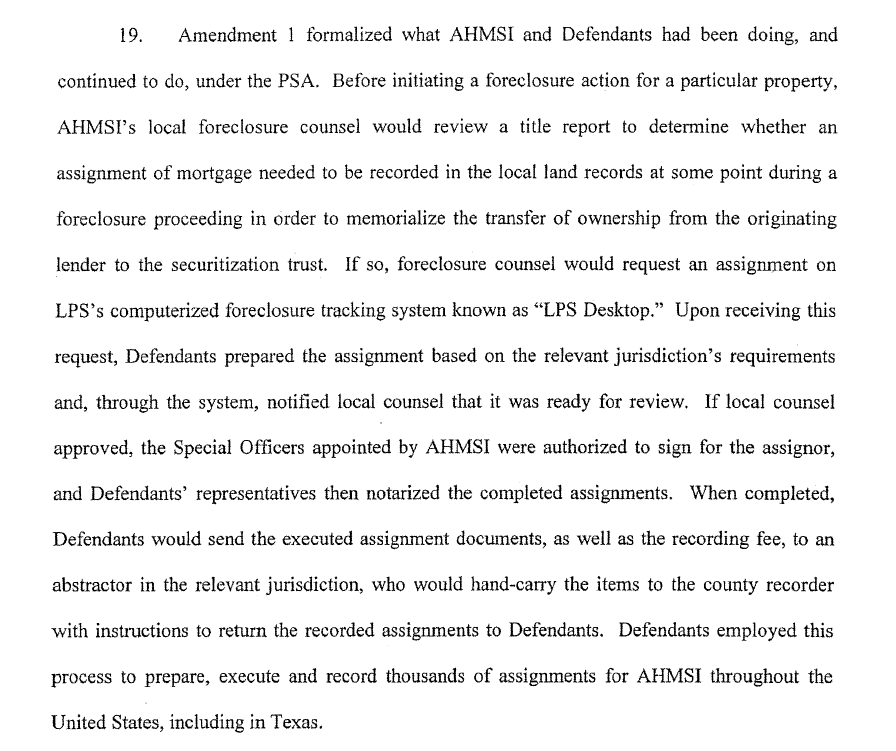
Did you get it? They said that these procedures were standard between the two companies, which was to “..to memorialize the transfer of ownership lender to the securitization trust” right before initiating foreclosure. If you are a regular reader of this blog, you know that is impermissibly late. The note and mortgage had to get to the trust by a clearly specified date, usually 90 days after closing. As we’ve written numerous times, in the overwhelming majority of cases, the securitization entity was a New York trust, and New York trusts are like computer code, they can only operate exactly as stipulated. The exception was trusts by Chase and WaMu, which did allow for the originator to serve as custodian for the trust.
So AHMSI has just admitted that all of its foreclosures done with LPS were completed by the wrong party. In Alabama, wrongful foreclosures are subject to statutory damages of three times the value of the house, and recent cases have awarded much higher multiples of the property’s value. This little paragraph is a litigation goldmine for the right attorneys. I hope they have fun with it.
I’ve included the entire filing.

7 Responses

  1. In my situation the assignment of the mortgage (which occurred post BK discharge and right before foreclosure) was done in favor of a bank which has nothing to do with my loan. It is not the owner or investor trust per the MERS records. Why didn’t the servicer simply assign the mortgage to itself? I have reason to believe the assignee bank never even knew about the transaction or even that it is a plaintiff in this case. Anyone have thoughts or advice?

  2. @carie – where are you getting that position? i’ve seen you discuss it ad nauseum, but i admit i’ve never really following the reasoning

  3. More of the same BS:
    Neil said:
    “The bottom line is that the securitization of mortgages loans never actually happened. The defects in the origination process, the absence of transfer documents and delivery in accordance with the pooling and servicing agreements are incurable.”
    Neil—who are you protecting??? The securitization never happened, because the LOANS NEVER HAPPENED—
    THIS IS WHAT HAPPENED…and you know it:
    “…Subprime refinance was unsecured — a false and fraudulent mortgage — and nothing more than debt collection on a fraudulent transfer of collection rights to a false default debt. Everyone (in subprime refinance) was in (false) default before they even refinanced.
    The banks (as debt buyers) accomplished this by falsely placing borrower in current default (and never telling them) — and then the servicer purchases the collection rights from either Freddie or Fannie. Then the servicer “reinstates” the false default debt with a fraudulent refinance. And, if there is a subsequent refinance, that is just another transfer of collection rights. Servicer reports original F/F mortgage as “paid” — but it is “Paid-OUT” — by servicer purchase — and not “Paid-OFF” by the borrower as it should have been by the (fraudulent) subprime refinance. . Thus, borrower remains in default on F/F loan – despite a subprime refinance — and borrower can never refinance with an F/F again — They are doomed if they miss even one payment on the false collection rights — and will never recover because always held in default — on both the F/F loan and the collection rights. BUT BORROWERS should not be paying on fraud!!!! They have a right withhold payments on fraudulent debt.
    All fraudulent, all in violation of consumer protection laws — and, because the “creditor” of collection right never validates the “debt” — by disclosing the actual creditor to the false default debt — in violation of FDCPA and May 2009 TILA Amendment. Meaning borrowers should not be paying anything — because of fraud and violation of federal statutes.”

  4. @davies – indeed. no matter how evil you think the bank is, two wrongs don’t make a right as far as the courts are concerned. i’ve seem similar schemes result in a referral to the district atty from the judge

  5. Homeowners beware of filing any documents on the land title record that are bogus. It will eventually catch up with you and the law.
    Bank of America N. A. as successor in interest to Countrywide Bank N. A, and Bank of America Home Loan Services vs. Denise Honc, Dan Shabtai, Boyan Panajotov, Moonraven Medicine Bird, Does 1-100.

  6. Neil Garfield, you are an angel for pointing things out and pointing people in the right direction, Lawyers too. This is great news and I hope as you do too that lawyers get this and use this information to help homeowners who need this break! Thank you for being there.

  7. so many moving parts here, but how do you reconcile this with the premise that the security follows the note generally?


Enhanced by Zemanta

Wednesday, August 24, 2011

““Like a sale of land itself, the assignment of a mortgage is a conveyance of an interest in land that requires a writing signed by the grantor.” Ibanez, 458 Mass at 649. Deutsche had not received a written assignment of the mortgage from MERS prior to May 3, 2011. The fact that it had possession of the mortgage instrument did not render Deutsche the mortgagee and thus it lacked the power to sell the property.”


DEUTSCH LOSES AGAIN: POOL DID NOT RECEIVE LOAN

MOST POPULAR ARTICLES

TRANSFER TO POOL AFTER FORECLOSURE INITIATED: VOID

 The fact that Deutsche had possession of the mortgage, however, is irrelevant to its status as mortgagee. While a promissory note endorsed in blank may be enforced by the party in possession of the note, this is not the case with a mortgage”
“Like a sale of land itself, the assignment of a mortgage is a conveyance of an interest in land that requires a writing signed by the grantor.” Ibanez, 458 Mass at 649. Deutsche had not received a written assignment of the mortgage from MERS prior to May 3, 2011. The fact that it had possession of the mortgage instrument did not render Deutsche the mortgagee and thus it lacked the power to sell the property.”
In re: SIMA SCHWARTZ, Chapter 7, Debtor.
SIMA SCHWARTZ, Plaintiff,
v.
HOMEQ SERVICING, AGENT FOR DEUTSCHE BANK NATIONAL TRUST COMPANY, AS TRUSTEE and DEUTSCHE BANK NATIONAL COMPANY, AS TRUSTEE, Defendants.
Case No. 06-42476-MSH, Adversary Proceeding No. 07-04098.
United States Bankruptcy Court, D. Massachusetts, Central Division.
August 22, 2011.
David G. Baker, Boston, MA, for the plaintiff.
Christopher Matheson, Richard C. Demerle and Christopher Decosta, Michienzie & Sawin, LLC, Boston, MA, for both defendants.
Gary A. Barnes, Sarah-Nell Walsh, Baker, Donelson, Bearman, Caldwell & Berkowitz, P.C., Atlanta, GA, for Defendant Deutsche Bank National Trust Company, as Trustee.
MEMORANDUM OF DECISION AND ORDER
MELVIN S. HOFFMAN, Bankruptcy Judge.
After the plaintiff, Sima Schwartz, presented her case in chief during the first day of the trial in this adversary proceeding, upon oral motion of the defendants, HomEq Servicing and Deutsche Bank National Trust Company, as Trustee, I granted judgment on partial findings in favor of the defendants on all counts of the complaint, pursuant to Fed. R. Civ. P. 52(c), made applicable to this proceeding by Fed. R. Bankr. P. 7052. Ms. Schwartz then moved for a new trial as a result of which judgment was vacated on count I of the complaint only.Schwartz v. HomEq Servicing (In re Schwartz), 2011 WL 1331963 (Bankr. D. Mass. Apr. 7, 2011). In count I, Ms. Schwartz alleges that the May 24, 2006 foreclosure sale of her home by Deutsche was invalid because Deutsche did not own the mortgage on the property at the relevant time.1 I reopened the trial so that the defendants could present their case with respect to that count, which they did on June 1, 2011. Based on the evidence and legal submissions presented by the parties, my findings of fact, conclusions of law and order are set forth below.
Jurisdiction and Standing
Core jurisdiction over this case is conferred upon the bankruptcy court by 28 U.S.C. § 157(b)(2)(G) and (O). See Atighi v. DLJ Mortg. Capital, Inc. (In re Atighi), 2011 WL 3303454, at *3 (B.A.P. 9th Cir. Jan. 28, 2011). Ms. Schwartz’s standing to seek relief is based on her property interest in light of the alleged wrongful foreclosure. Brae Asset Fund, L.P. v. Kelly, 223 B.R. 50, 56 (D. Mass. 1998).
Legal Framework
Mass. Gen. Laws ch. 244, § 14 establishes the procedure for a mortgagee to foreclose a mortgage by exercise of the statutory power of sale. The statute provides that prior to a foreclosure sale a notice of the sale must appear weekly for three consecutive weeks in a newspaper either published in or generally circulated in the city or town where the property is located. The Massachusetts Supreme Judicial Court has recently clarified that a foreclosing mortgagee must hold the mortgage as of the date that the first notice of sale is published.U.S. Bank Nat. Ass’n v. Ibanez, 458 Mass. 637, 941 N.E.2d 40 (2011). If the party intending to foreclose the mortgage is not the original mortgagee, a typical state of affairs when a mortgage loan is owned by the trustee of a securitized pool of mortgage loans, then the foreclosing mortgagee must hold a valid assignment of the mortgage prior to publishing the first sale notice.
The Defendants’ Case
It is undisputed that Deutsche was not the original mortgagee of the mortgage on Ms. Schwartz’s home, so it must prove that the mortgage was assigned to it prior to the date when the first foreclosure notice was published. As discussed in the memorandum and order on the plaintiff’s motion for a new trial, while the evidence established that an assignment of the mortgage from Mortgage Electronic Registration Systems, Inc. (“MERS”) to Deutsche was executed on May 23, 2006, the day before the foreclosure sale, this assignment, being well after the notice of foreclosure sale was first published, did not confer on Deutsche the power to foreclose on May 24. The Supreme Judicial Court in Ibanez,however, offered an alternative method for a party to acquire sufficient rights in a mortgage to qualify to foreclose:
Where a pool of mortgages is assigned to a securitized trust, the executed agreement that assigns the pool of mortgages, with a schedule of the pooled mortgage loans that clearly and specifically identifies the mortgage at issue as among those assigned, may suffice to establish the trustee as the mortgage holder.
Ibanez, 458 Mass. at 651.
With this in mind, the defendants introduced into evidence at trial all of the agreements tracking the transfer of Ms. Schwartz’s mortgage loan from its originator, First NLC Financial Services, LLC (“First NLC”), to Deutsche, complete with the necessary schedules of the pooled mortgage loans specifically identifying her mortgage as being among those transferred. The defendants argue that these agreements, together with other evidence introduced by them, establish that Deutsche was the holder of the mortgage well in advance of the first publication of the notice of sale.
At trial, Ronaldo Reyes, a Deutsche vice president, testified that he had management responsibility over the administration of the Morgan Stanley Home Equity Loan Trust 2005-4 (the “Trust”) and that Deutsche had always been the trustee of the Trust. He testified that in his capacity as vice president he had access to the books and records of the Trust and was qualified to authenticate and testify about the documents admitted into evidence by the defendants. During the course of his testimony, Mr. Reyes authenticated executed copies of each of the agreements discussed below, and demonstrated that Ms. Schwartz’s mortgage loan was included on the mortgage loan schedules attached as exhibits to several of the agreements. Mr. Reyes testified that each was used in the ordinary course of Deutsche’s business as trustee of the Trust.
The following documents were admitted into evidence: (i) the mortgage on Ms. Schwartz’s home; (ii) the original promissory note executed by Ms. Schwartz, which Mr. Reyes noted was endorsed in blank by First NLC; (iii) the Amended and Restated Mortgage Loan Purchase Agreement (the “Loan Purchase Agreement”) dated as of September 1, 2005 by and between Morgan Stanley Mortgage Capital, Inc. (“MS Mortgage Capital”) and First NLC; (iv) the Assignment and Conveyance Agreement dated September 29, 2005, by and between First NLC and MS Mortgage Capital; (v) the Bill of Sale dated November 29, 2005 by and between MS Mortgage Capital and Morgan Stanley ABS Capital I Inc. (“MS ABS Capital”); and (vi) the Pooling and Servicing Agreement (the “PSA”) dated as of November 1, 2005 by and among MS ABS Capital, HomEq Servicing Corporation, JPMorgan Chase Bank, National Association, First NLC, LaSalle Bank National Association and Deutsche. Mr. Reyes also testified regarding a custodial log that was admitted into evidence for the purpose of proving that Ms. Schwartz’s loan documents were in Deutsche’s custody prior to the date when the first notice of foreclosure sale was published.
Findings of Fact2
1. On July 22, 2005, Ms. Schwartz refinanced the mortgage loan on her property at 23 Sigel Street, Worcester, Massachusetts, executing a promissory note in the amount of $272,000 payable to First NLC and a mortgage securing her obligation under the note naming MERS, solely as nominee for First NLC, its successors and assigns, as mortgagee.
2. The mortgage, which was duly recorded at the Worcester District Registry of Deeds, includes the statutory power of sale under Mass. Gen. Laws. ch 183, § 21 which is invoked by reference to the statute and which permits a mortgagee to foreclose a mortgage by public auction sale of the property upon the mortgagor’s default in performance or breach of any conditions thereof.
3. On May 3, May 10 and May 17, 2006, a notice of foreclosure sale was published in the Worcester Telegram and Gazette stating that “Deutsche Bank National Trust Company, as Trustee,” the “present holder” of the mortgage, intended to foreclose the mortgage by public sale of Ms. Schwartz’s property on May 24, 2006.
4. On May 23, 2006, Liquenda Allotey, described as a vice president of MERS, executed an Assignment of Mortgage for the purpose of assigning the mortgage from MERS to “Deutsche Bank National Trust Company, as Trustee.”
5. Deutsche, in its capacity as trustee of the Trust,3 conducted the foreclosure sale as scheduled on May 24, 2006, bid in its mortgage debt and purchased the property.
6. In its answer, Deutsche admitted that a foreclosure deed conveying the property to itself was recorded on October 13, 2006. There has been no evidence presented of any subsequent conveyance of the property and hence I find that Deutsche remains the record owner of the Sigel Street property.
7. As she testified on the first day of trial, Ms. Schwartz continues to reside in the Sigel Street Property.
8. The original promissory note executed by Ms. Schwartz was endorsed in blank by an officer of First NLC.
9. The original mortgagee as identified in the mortgage on Ms. Schwartz’s home was MERS, as nominee for First NLC, its successors and assigns.
10. In accordance with Section 2 of the Loan Purchase Agreement, First NLC agreed to sell “Mortgage Loans” to MS Mortgage Capital.
11. The Loan Purchase Agreement defines a “Mortgage Loan” as
An individual Mortgage Loan which is the subject of this Agreement, each Mortgage Loan originally sold and subject to this Agreement being identified on the applicable Mortgage Loan Schedule, which Mortgage Loan includes without limitation the Mortgage File, the Monthly Payments, Principal Prepayments, Liquidation Proceeds, Condemnation Proceeds, Insurance Proceeds, Servicing Rights and all other rights, benefits, proceeds and obligations arising from or in connection with such Mortgage Loan, excluding replaced or repurchased mortgage loans.
12. On September 29, 2005, by way of the Assignment and Conveyance Agreement, First NLC sold, transferred, assigned, set over and conveyed to MS Mortgage Capital “all right, title and interest of, in and to the Mortgage Loans listed on the Mortgage Loan Schedule attached hereto as Exhibit A.”
13. Ms. Schwartz’s mortgage loan was listed on the exhibit attached to the Assignment and Conveyance Agreement.
14. First NLC, therefore, transferred all of its right, title and interest in Ms. Schwartz’s mortgage loan to MS Mortgage Capital on November 29, 2005.
15. By the Bill of Sale dated November 29, 2005, MS Mortgage Capital, as the “Seller,” transferred to MS ABS Capital “all the Seller’s right, title and interest in and to the Mortgage Loans described on Exhibit A attached hereto.”
16. Ms. Schwartz’s mortgage loan was listed on Exhibit A to the Bill of Sale.
17. MS Mortgage Capital, therefore, transferred its entire interest in Ms. Schwartz’s mortgage loan to MS ABS Capital on November 29, 2005.
18. Section 2.01 of the PSA, which was dated November 1, 2005, provides that the MS ABS Capital, as “Depositor,”
concurrently with the execution and delivery hereof, hereby sells, transfers, assigns, sets over and otherwise conveys to [Deutsche] for the benefit of the Certificateholders, without recourse, all the right, title and interest of the Depositor in and to the Trust Fund, and the Trustee, on behalf of the Trust, hereby accepts the Trust Fund.
19. The “Trust Fund” includes all of the mortgage loans listed on an attached mortgage loan schedule.
20. Ms. Schwartz’s mortgage loan was listed on the mortgage loan schedule attached to the PSA.
21. While the PSA provides that the mortgage loans were transferred from MS ABS Capital to Deutsche, “concurrently with the execution and delivery hereof” on November 1, 2005, the Bill of Sale provides that MS ABS Capital did not acquire the mortgage loans until November 29, 2005. The November 2009 PSA indicates, however, that the transaction in which MS ABS Capital would transfer the loans to Deutsch, as trustee of the Trust, would not be consummated until November 29, 2005, which is defined as the “Closing Date.” Therefore, MS ABS Capital transferred Ms. Schwartz’s mortgage loan to Deutsche, as trustee of the Trust, on the Closing Date of November 29, 2005, which is the same date as the Bill of Sale by which MS ABS Capital acquired the loan from MS Mortgage Capital.
22. Section 2.01(b) of the PSA provides that if
any Mortgage has been recorded in the name of Mortgage Electronic Registration System, Inc. (“MERS”) or its designee, no Assignment of Mortgage in favor of the Trustee will be required to be prepared or delivered and instead, the applicable Servicer shall take all reasonable actions as are necessary at the expense of the applicable Originator to the extent permitted under the related Purchase Agreement and otherwise at the expense of the Depositor to cause the Trust to be shown as the owner of the related Mortgage Loan on the records of MERS for the purpose of the system of recording transfers of beneficial ownership of mortgages maintained by MERS.
23. Thus MS ABS Capital did not assign to Deutsche the mortgage on Ms. Schwartz’s home in connection with the transaction through which it transferred Ms. Schwartz’s mortgage loan pursuant to the PSA.
24. In the chain of transactions by which Ms. Schwartz’s mortgage loan was sold, initially by First NLC to MS Mortgage Capital, next by MS Mortgage Capital to MS ABS Capital and finally by MS ABS Capital to Deutsche, the seller sold all of its right, title and interest in the mortgage loans being transferred. However, as the mortgage itself was originally in the name of MERS as mortgagee, and not First NLC, First NLC never held legal title to the mortgage and could not have transferred such title to MS Mortgage Capital. Consequently, neither MS ABS Capital nor Deutsche, as successors to First NLC and MS Mortgage Capital, obtained legal title to the mortgage. This is consistent with § 2.01 of the PSA quoted above.
25. As of November 29, 2005, the Closing Date defined in the PSA, MERS continued to hold legal title to the mortgage on Ms. Schwartz’s home as nominee for First NLC, its successors and assigns.
26. MERS continued to hold legal title to the mortgage until May 23, 2006, when it assigned the mortgage to Deutsche.
27. The custodial log establishes that Deutsche received Ms. Schwartz’s mortgage loan documents, including the promissory note and mortgage instrument, on September 15, 2005 (presumably in anticipation of the November loan sale), and retained custody of these documents until March 27, 2006, when they were sent to HomEq. The custodial log indicates that the documents were sent to HomEq for servicing and lists the reason for the transfer as “foreclosure.” According to the custodial log, the loan documents were returned to Deutsche on May 24, 2006, the day of the foreclosure sale.
Conclusions of Law
In In re Marron, 2011 WL 2600543, at *5 (Bankr. D. Mass. June 29, 2011), I held that where a loan was secured by a mortgage in the name of MERS, even when the loan itself changed hands several times, MERS remained the mortgagee in its capacity as nominee for the original lender, its successors and assigns.4 As MERS was the mortgagee, it had the authority to assign the mortgage to the foreclosing entity. In this case too, while Ms. Schwartz’s loan passed from hand to hand, MERS remained the mortgagee throughout. While MERS held only bare legal title to the mortgage on behalf of Deutsche, the successor to First NLC, until it assigned the mortgage to Deutsche on May 23, 2006, only MERS had the authority to foreclose.
Having determined that MERS, and not Deutsche, held legal title to the mortgage on Ms. Schwartz’s home mortgage as of May 3, 2006, when the notice of the foreclosure sale of her home was first published, it follows that Deutsche did not have the right to exercise the statutory power of sale and to foreclose the mortgage. See, e.g., Novastar Mortgage, Inc. v. Safran, 79 Mass.App.Ct. 1124, 948 N.E.2d 917 (2011) (finding, in a post-foreclosure eviction proceeding, that the foreclosing entity had the burden to prove its title to the property by establishing that the mortgage had been assigned to it by MERS “at the critical stages of the foreclosure process.”). By publishing notice of the foreclosure sale when it was not the mortgagee, Deutsche failed to comply with Mass. Gen. Laws ch. 244, § 14, and thus its foreclosure sale is void. Ibanez, 438 Mass. at 646-47.5 A declaratory judgment to that effect shall enter on count I of the complaint.
SO ORDERED.
Footnotes
1. The complaint is unclear as to the relief Ms. Schwartz seeks as a result of the allegedly invalid foreclosure. In addition to the allegation that the defendants did not own the mortgage, Ms. Schwartz alleges that she was damaged by the foreclosure sale, which “was conducted fraudulently, in bad faith” and to her detriment. I previously found that Ms. Schwartz failed to produce any evidence of the defendants’ intent to defraud her. In addition, Ms. Schwartz failed to establish the extent of her damages or that the foreclosure sale was conducted in bad faith. Though Ms. Schwartz does not expressly request a declaratory judgment as to the validity of the foreclosure, based on the allegation of invalidity in the complaint, and the parties’ arguments in the course of trial, I will consider count I of the complaint to be a request for a declaratory judgment that the foreclosure sale was invalid.
Back to Reference
2. Any finding of fact which should more properly be considered a conclusion of law, and vice versa, shall be deemed as such.
Back to Reference
3. The documents pertaining to the foreclosure sale identify Deutsche as “Deutsche Bank National Trust Company, as Trustee” without identifying the trust.
Back to Reference
4. The sophisticated financial minds who wrought the MERS regime sought to simplify the process of repeatedly transferring mortgage loans by obviating the need and expense of recording mortgage assignments with each transfer. No doubt they failed to consider the possibility of a collapse of the residential real estate market, the ensuing flood of foreclosures and the intervention of state and federal courts. Professor Alex Tabarrok of George Mason University has observed “[t]he law of unintended consequences is when a simple system tries to regulate a complex system.” Alex Tabarrok, The Law of Unintended Consequences, Marginal Revolution (Jan. 24, 2008, 7:47 am), http://marginalrevolution.com/marginalrevolution/2008/01/the-law-of-unin.html.
Back to Reference
5. Deutsche presented sufficient evidence to prove that either it or HomEq, its agent, had possession of both the Schwartz mortgage and promissory note as of May 3, 2011. The note was endorsed in blank, which gave Deutsche the right to enforce the note. The fact that Deutsche had possession of the mortgage, however, is irrelevant to its status as mortgagee. While a promissory note endorsed in blank may be enforced by the party in possession of the note, this is not the case with a mortgage“Like a sale of land itself, the assignment of a mortgage is a conveyance of an interest in land that requires a writing signed by the grantor.” Ibanez, 458 Mass at 649. Deutsche had not received a written assignment of the mortgage from MERS prior to May 3, 2011. The fact that it had possession of the mortgage instrument did not render Deutsche the mortgagee and thus it lacked the power to sell the property.
Back to Reference

2 Responses

  1. Carie
    Like I said in a prior posting, every institution is conspiring to either protect the banks and their agents and “surrogates” from criminal liability outright, or to pretend their friends are noble captains of industry keeping us from a new Dark Ages…..

  2. GOVERNMENT COVER-UPS ON UNPRECEDENTED SCALE—AND YOU THINK THEY WON’T DO IT WITH THE “FAKE” MORTGAGES??? THINK AGAIN—AND KEEP FIGHTING!!!
    “…AMY GOODMAN: Under whose authority?
    MATT TAIBBI: Under the authority of the enforcement division. Now, this—there’s no legal authority to do this. And, you know, apparently, according to my sources, this was illegal. You can’t just unilaterally shred any government document, no matter how insignificant. And these are significant law enforcement investigatory files that they were unilaterally destroying…”


Enhanced by Zemanta